Research
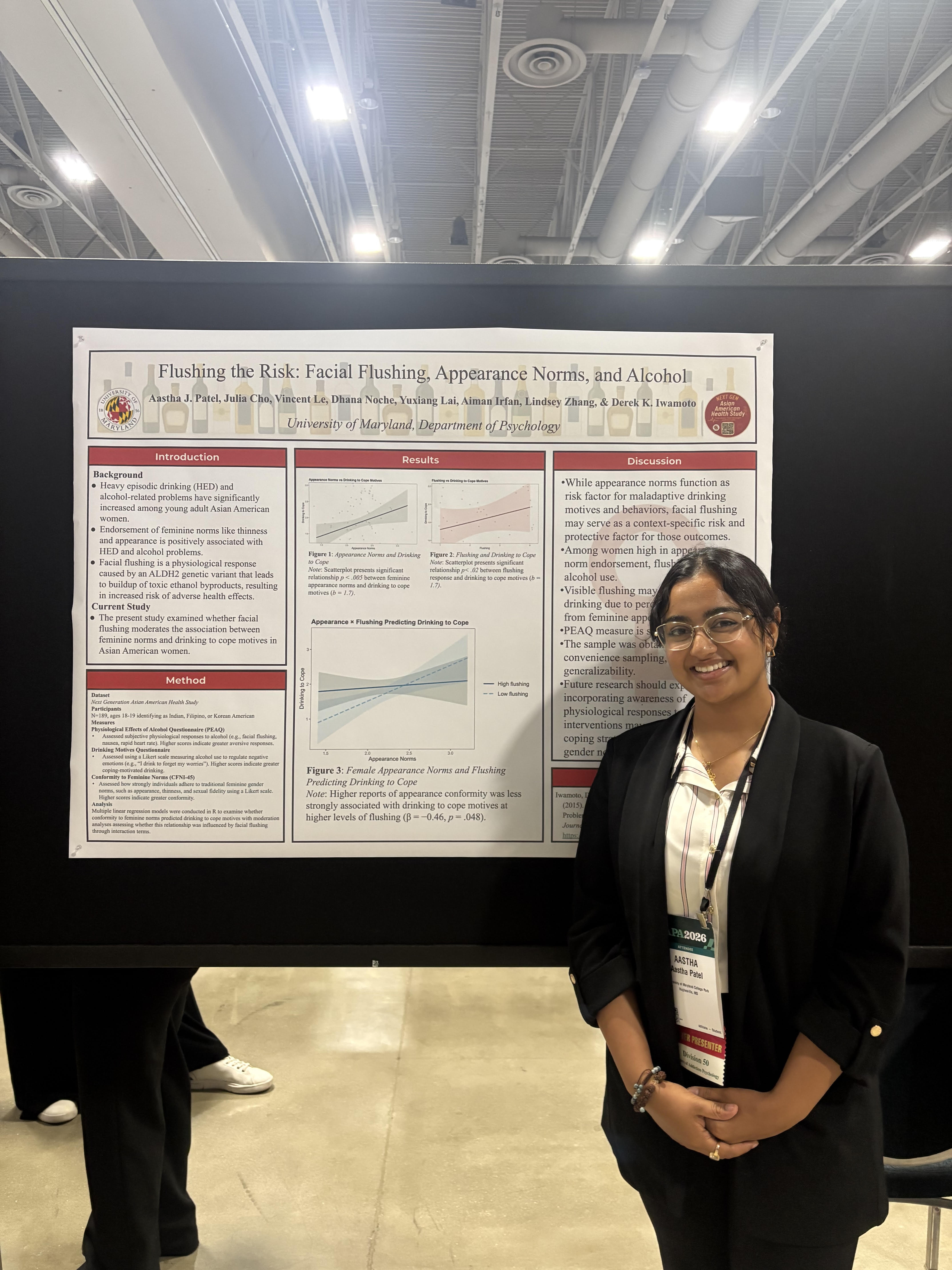
Flushing the Risk: Facial Flushing, Appearance Norms, and Alcohol
Patel, A., Cho, J., Le, V., Lai Y., Noche, D., Irfan A., Zhang, L., & Iwamoto, D. (2026). Flushing the Risk: Facial Flushing, Appearance Norms, and Alcohol. Poster presented at the American Psychological Association(APA) Conference, Washington, D.C., 7 August 2026.
Over the past decade, rates of heavy episodic drinking (HED) and alcohol-related problems have significantly increased among young adult Asian American women, highlighting the need to identify relevant risk and protective factors. One theoretically relevant factor that has been linked to alcohol-related problems among this group includes multidimensional feminine norms, or societal expectations of womanhood. Endorsement of thinness and appearance norms has been found to be positively associated with HED and alcohol problems, whereas sexual fidelity norms are protective. However, limited research has examined moderators that reduce risk among women endorsing these norms. The present study examined whether facial flushing, a physiological response linked to alcohol sensitivity, moderates the association between appearance norms and drinking to cope motives in Asian American women. Participants (N=189, ages 18-19) completed the conformity to feminine norms (appearance, thinness and sexual fidelity), facial flushing, HED, and drinking to cope motives. Regression analyses revealed that appearance and flushing increased risk of using drinking to cope motives and HED. A significant interaction between appearance conformity and facial flushing emerged such that appearance conformity was less strongly associated with drinking to cope motives at higher levels of flushing (β = −0.46, p = .048). These findings suggest that while appearance norms function as risk factor for maladaptive drinking motives and behaviors, facial flushing may serve as a context-specific risk and protective factor for those outcomes. Alone, flushing is significantly related to the alcohol outcomes; however it also served as a protective factor for women who endorse appearance norms. That is, women who endorse appearance norms may limit alcohol use when flushing occurs, as visible facial redness may be perceived as deviating from socially prescribed standards of feminine appearance. Clinical interventions may incorporate awareness of physiological outcomes of alcohol to promote adaptive coping strategies while avoiding gender norm endorsement.
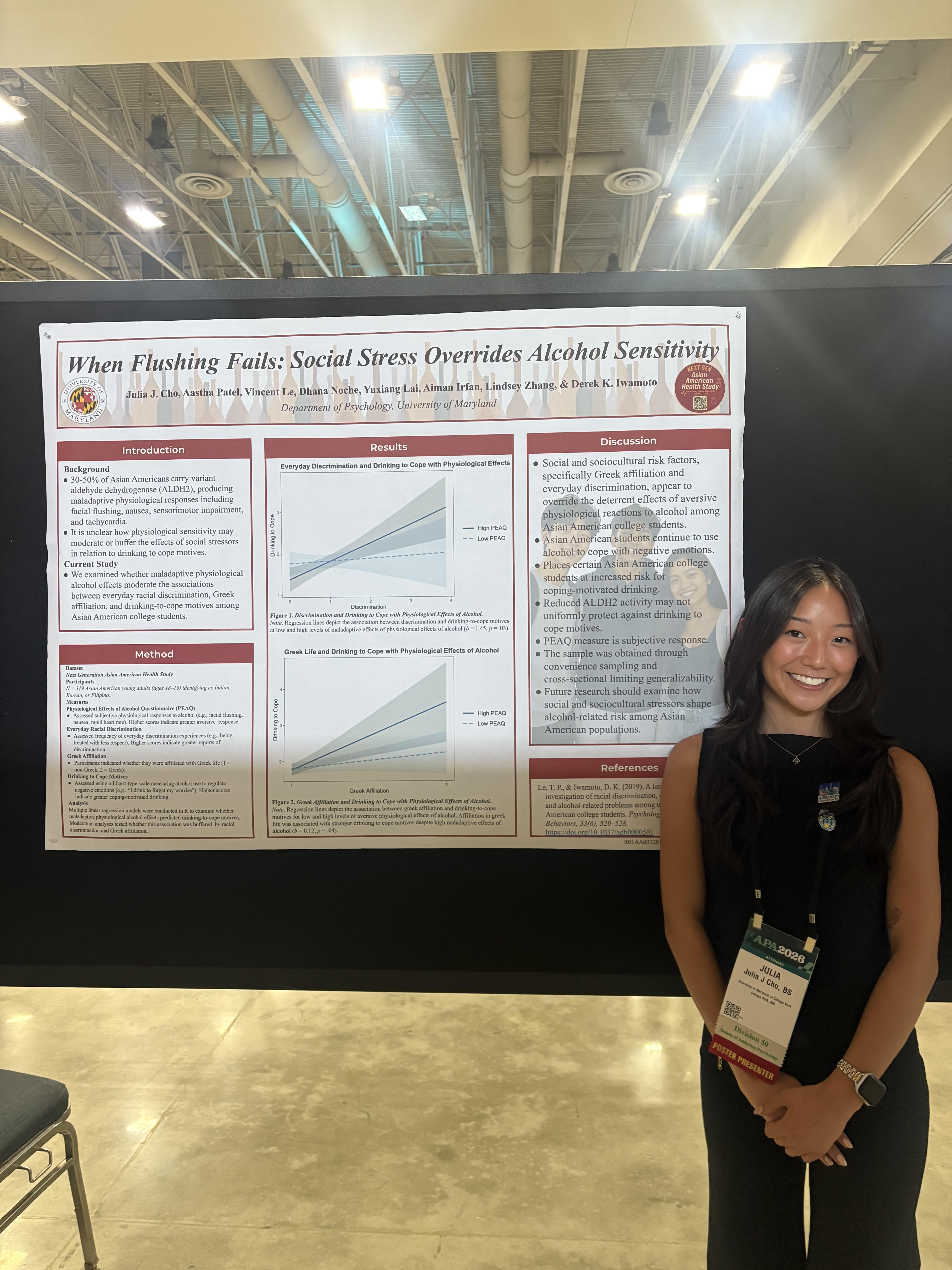
When Flushing Fails: Social Stress Overrides Alcohol Sensitivity
Cho, J., Patel, A., Le, V., Noche, D., Lai, Y., Irfan, A., Zhang, L., & Iwamoto, D. (2026, April 22). When Flushing Fails: Social Stress Overrides Alcohol Sensitivity. Poster presented at the American Psychological Association(APA) Conference, Washington, D.C., 8 August 2026.
Around 30-50% Asian Americans carry variant aldehyde dehydrogenase (ALDH2), which produces maladaptive physiological responses to alcohol, including facial flushing, nausea, sensorimotor impairment, and tachycardia. These aversive reactions have been conceptualized as protective against alcohol use. However, it is unclear how this physiological subjective response may moderate or buffer the effects of social stressors and how it relates to proximal risk factors, including drinking to cope, which refers to regulating negative emotions through alcohol. Longitudinal research has shown that racial discrimination is associated with drinking to cope motives and increases alcohol-related problems. Greek affiliation has also been linked to alcohol-related problems (Le & Iwamoto, 2019). The current study examined whether maladaptive physiological alcohol effects moderate the associations between everyday racial discrimination, Greek affiliation, and drinking-to-cope motives among Asian American college students. Participants (N = 319; ages 18-19) completed measures of discrimination, Greek affiliation, maladaptive physiological alcohol effects, and drinking to cope motives. Multiple regression and moderation analysis indicated that more severe maladaptive physiological effects (b = -1.35, p < .001) were associated with lower drinking to cope motives (R² = .07). However, this protective association was eliminated among students in Greek life (b = 1.45, p = .03) and those reporting higher racial discrimination (b = 0.12, p = .04). These findings indicate that maladaptive physiological effects are generally associated with reduced drinking-to-cope motives; however, this protective association is context dependent. Social and sociocultural risk factors, specifically Greek affiliation and racial discrimination, appear to override the deterrent effects of aversive physiological reactions, placing certain Asian American college students at increased risk for coping-motivated drinking. Thus, reduced ALDH2 activity may not uniformly protect against drinking to cope motives. Future research should examine how social and sociocultural stressors shape alcohol-related risk among Asian American populations.
Seeing and Believing: Link between vicarious racism, internalized model minority myth and anxiety
Noche, D., Lai Y., Cho, J., Le, Patel, A., Le, V., Irfan A., Zhang, L., & Iwamoto, D. (2026). Seeing and Believing: Link between vicarious racism, internalized model minority myth and anxiety. Poster presented at the PSYC Research Fair, College Park, MD, 22 April 2026.
The internalization of the model minority myth (MMM) and discrimination have been found to impact psychological distress in Asian Americans. The MMM includes stereotypes that consist of two aspects: achievement orientation (M-Achievement), the belief that Asian Americans’ success is attributed to achievement, and unrestricted mobility (M-Mobility), the belief that Asian Americans have unrestricted upward mobility. Another potential social stressor is vicarious racism, which is the experience of racial discrimination through a secondary route, including social media. The current study examined the associations between vicarious discrimination, internalized model minority myth, and generalized anxiety symptomatology while controlling for social support among Asian American (Korean, Indian, Filipino) young adults. Participants (N = 319; ages 18-19) completed self-report measures, and multiple regression analyses revealed that vicarious racism (β = -.102, p = .034), unrestricted internalized model minority myth beliefs (β = -.175, p < .001) and social support (β = -.249, p = .004) were negatively associated with generalized anxiety symptoms, R² = 0.104, F(5, 286) = 7.617, p < .001. Findings suggest that individuals who have lower endorsement of internalized model minority stereotypes and social support reported less anxiety. Individuals who reported vicarious racism noted less anxiety which may reflect how this type of exposure may foster stronger racial identity salience and individuals may be less surprised by this threat. Further research is needed to disentangle this relationship, and translational implication will be discussed.

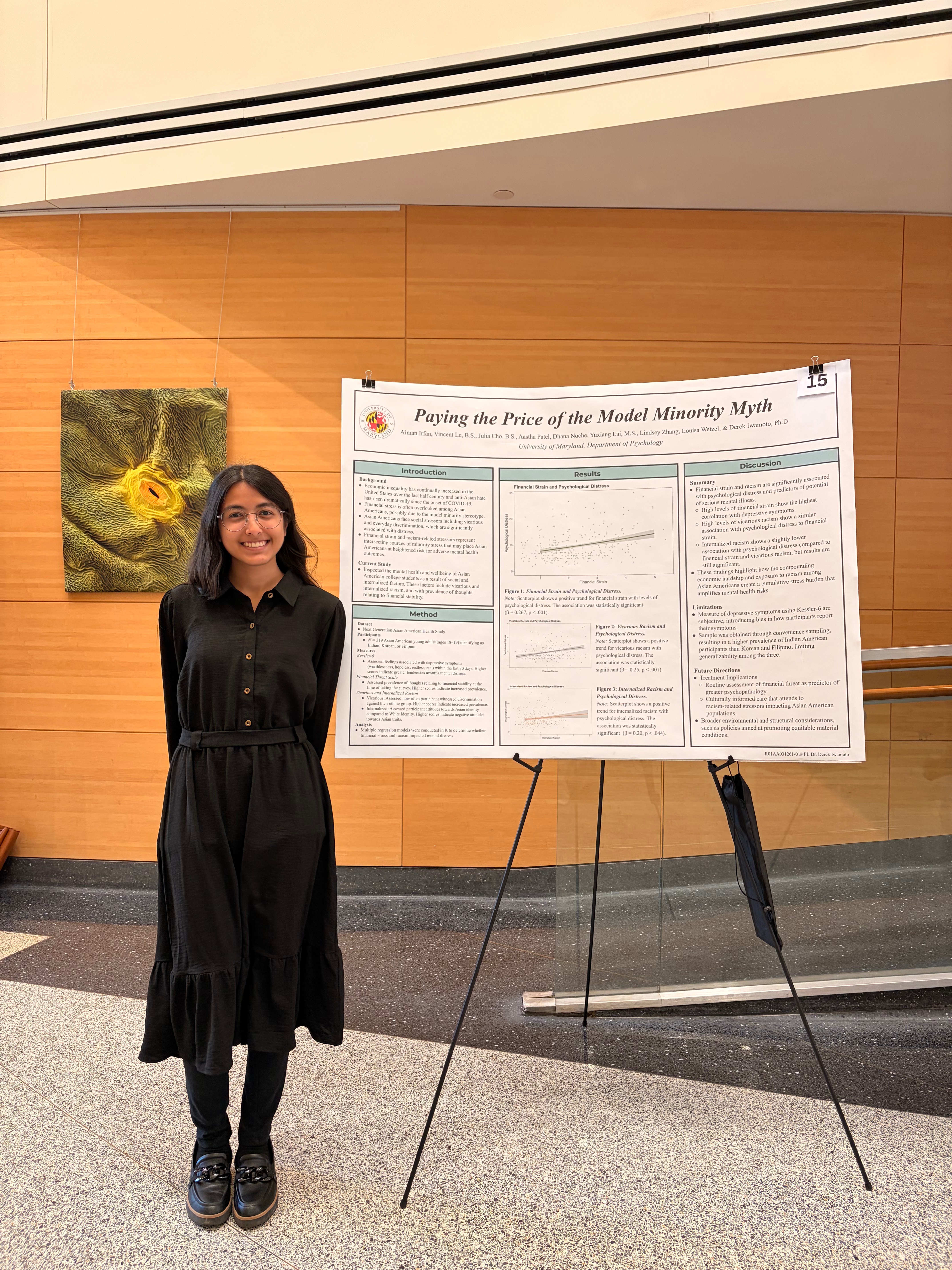
Paying the Price of the Model Minority Myth
Irfan A., Le, V., Cho, J., Patel, A., Noche, D., Lai Y., Zhang, L., & Iwamoto, D. (2026). Paying the Price of the Model Minority Myth. Poster presented at the PSYC Research Fair, College Park, MD, 22 April 2026.
Economic inequality has continually increased in the United States over the last half century and anti-Asian hate has risen dramatically since the onset of COVID-19. The minority stress model posits that minority stressors, such as poverty and racial discrimination, lead to adverse health outcomes unrelated to the stressors of everyday life. Despite the persistence of the model minority myth, Asian Americans also experience financial stress, an overlooked stressor. Salient social stressors experienced by Asian Americans also include both vicarious and everyday discrimination, which have been linked to distress. Together, financial strain and racism-related stressors represent intersecting sources of minority stress that may place Asian Americans at heightened risk for psychological distress and adverse mental health outcomes. The present study is the first to explore the impact of financial threat and different forms of racism on psychological distress among Asian Americans. Participants (N = 319; ages 18–19) completed the Financial Threat Scale, Kessler-6, and measures examining explicit, vicarious, and internalized racism. The multiple regression model revealed higher financial stress (β = 0.267, p < .001), vicarious racism (p < .001), and internalized racism (p = .044) were significantly associated with greater psychological distress, whereas everyday discrimination was not. Results suggest that financial strain and racism, most notably vicarious racism, are associated with psychological distress and predictors of potential of serious mental illness. Treatment implications include the routine assessment of financial threat as predictor of greater psychopathology, alongside broader environmental and structural considerations, such as policies aimed at promoting equitable material conditions. Additionally, these findings highlight the importance of culturally informed care that attends to racism-related stressors impacting Asian American populations.